

Second season, Third chapter
Wulong Tea 乌龙茶
The Alchemy of Oxidation: A Journey into the Soul of Wulong Tea

CLUB COMMUNITY
Join the conversation with Vivian and with fellow tea drinkers who joined our club!
Publish tasting notes, questions and feelings on our community chat, reserved to everyone who joined our club.
In this third chapter of our Tea Club journey, we invite you to explore the world of Chinese Wulong teas - the most complex and captivating category in the world of tea. We have curated eight exceptional Wulongs that represent the pinnacle of craftsmanship, each telling a unique story of terroir, tradition, and transformation.
Our journey spans the ancient tea mountains of China, from the mineral-rich cliffs of Wuyishan, where rock teas absorb the essence of stone, to the high-altitude forests of Yunnan, where tea plants thrive in vibrant ecosystems. We explore the legendary Tieguanyin gardens where tea trees grow alongside fruit orchards, and discover how each region's distinct climate and soil create teas with completely different personalities.
What makes this collection unique is the diversity within the Wulong family. You'll experience the singular "bug-bitten" Oriental Beauty with its honeyed complexity, the powerful cinnamon spice of Wuyi Rougui, and the elegant orchid notes of Tieguanyin. We've included teas from the prestigious Zhengyan core areas of Wuyushan to the accessible outer mountain gardens, allowing you to taste how terroir shapes character.
Through these eight teas, you'll witness the masterful "art of oxidation" where tea artisans skillfully balance between green tea's freshness and black tea's richness. Each tea represents a different point on the oxidation spectrum. This collection isn't just about tasting tea - it's about understanding the philosophy of 看青作青 Kan Qing Zuo Qing, where masters respond to each leaf's unique character.
This selection offers a wonderful opportunity to expand your tea experience, with each cup revealing the skills and tradition behind these exceptional teas.
©2025 Eastern Leaves, all rights reserved. Reproduction and distribution of this presentation, photos, text, without written permission of Eastern Leaves is prohibited.
harmony in diversity
Wulong Tea 乌龙
Wulong tea, also known as Qingcha, stands apart as a semi-oxidized tea. This unique processing method places it between green and black tea. The core of this craft is a unique artisanal process.
From a production-region perspective, Wulong tea is mainly concentrated in four provinces: Yunnan, Fujian, Guangdong, and Taiwan, forming different schools each with distinct regional characteristics and its own "signature flavour."
While all Wulongs share a basic process, each region has its own signature style. Fujian's northern Wulongs are more oxidised and heavily roasted, highlighting a mineral "rock rhyme." Southern Fujian and Taiwan styles vary from light to heavy oxidation, with more shaking to emphasise aroma. Guangdong Wulongs typically feature medium to high oxidation, with skilled baking to enhance their fragrance.
The guiding principle for all these styles is 看青作青 "Kàn qīng Zuò qīng" : observing the leaves and responding accordingly.
看青 Kàn qīng literally means "observing the green" and refers to the act of accurately observing the tea leaves during the oxidation process. The tea master carefully evaluates the colour, aroma, and texture of the leaves to determine the stage of oxidation.
作青 Zuò qīng means "working the green" and is the moment in which the master intervenes in the transformation process by shaking, resting, or aerating the leaves to modulate the level of oxidation, thus achieving the desired balance between freshness and body.
Together, Kàn qīng Zuò qīng represents the artisanal heart of the wulong tea production process: a sensitive and intuitive dialogue between the producer and the leaf, where experience and perception guide every gesture and shape the final taste of the tea.
This master process, combined with regional terroir, give a diversity of flavours, showcasing the cultural essence of Chinese Wulong tea: "harmony in diversity".


Historical Development
The history of Wulong tea can be traced back to Beiyuan tea from over 1000 years ago. Beiyuan refers to the area around modern Jian'ou in Fujian Province.
The famous Longtuan Fengbing (Dragon and Phoenix Cakes) of the Northern Song Dynasty can be considered a precursor to Wulong tea. The extremely high plucking standard and difficult mountain transport meant filling one basket of fresh leaves took a full day's work. The tea pickers trekked through mountains and rivers, and the fresh leaves jostled against each other in the baskets, gradually oxidising—similar to the modern Wulong process of "Yao Qing" (shaking/tumbling the leaves).
During the Ming Dynasty, the Wulong processing method gradually developed, transforming the process from unintentional to intentional.
It wasn't until the Yongzheng period of the Qing Dynasty that the truly defined Wulong tea processing technique emerged.
Wulong tea characteristics
Wulong's oxidation level falls between green tea and black tea, typically ranging from 10% to 70%. This unique degree of oxidation allows it to possess both the fresh aroma of green tea and the sweet mellowness of black tea, forming the typical appearance of "green leaves with red edges"—where the leaf edges turn red due to oxidation while the centre remains emerald green.
Another core characteristic of Wulong tea is its "high aroma and rich taste". Its aroma types are diverse, ranging from fresh and floral to fruity, honeyed, and mineral "Yan Yun" : the symphony of rocks that is the typical mineral taste of yancha. In terms of taste, emphasis is placed on the sweet aftertaste and the stimulation of saliva production. After drinking the tea, a sweetness arises in the mouth, and saliva production increases—this is an important standard for judging the quality of Wulong.
Ninger, Yunnan 云南省宁洱市
Oriental Beauty 东方美人
Oriental Beauty, also known as Baihao Wulong or Champagne Wulong, is a unique Wulong tea that originated from a leafhopper interaction with the tea plant.
茶小绿叶蝉 chá xiǎo lǜ yè chán, is the small green leafhopper of tea, known by the scientific name of Empoasca Pirisuga Matumura. When tea leaves are bitten by these small insects they develop a distinct honeyed and fruity aroma.
This tea is traditionally associated with Taiwan, however, it is also cultivated in mainland China—notably in Fujian, Yunnan, and Guangdong. The climate and environmental conditions in these production areas are similar, all located near the Tropic of Cancer at approximately 23°26' North latitude, with altitudes between 500-1000m.
What makes Oriental Beauty truly special is that it relies on this natural interaction. No pesticides can be used, making cultivation more challenging and the final product more precious. The leaves are hand-picked, usually one bud with two leaves, and undergo an additional step in processing: after fixation, they are wrapped and left to rest : a step known as moisture-returning or softening stage, in which a secondary oxidation is initiated. This step deepens the tea’s complexity, yielding a smooth, richly aromatic cup with no bitterness.


the Names of an Icon
The story about the origin of the name of this unique tea tells that when British merchants presented this tea to Queen Victoria of England, she praised it highly and called it "Oriental Beauty".
The term "Champagne Wulong", also used to refer to this tea, comes from the appearance of its liquor, which is as clear and bright as champagne.
The name "Baihao Wulong", where bai hao means "white fur", refers to the distinct white fur on the dry leaves.
While the story of Queen Victoria naming this tea may be more legend than history, its enduring reputation is undeniable. Oriental Beauty has maintained its status as one of China's most prized and expensive teas, celebrated by tea lovers worldwide for its truly unique qualities.
ORIENTAL BEAUTY CHARACTERISTICS
Oriental Beauty stands out among Wulong tea due to its high oxidation level of 60–85%, far beyond the typical range. This extensive oxidation, caused by the second step of oxidation, produces a flavour profile reminiscent of red tea : smooth, full-bodied, and completely free of astringency, while preserving the aromatic complexity of a Wulong tea.
Its visual signature is equally distinctive: the dry leaves are covered in white fur and display a striking mix of five colours: white, green, red, yellow, and brown.
Tengchong, Yunnan 云南省腾冲市
Tieguanyin 铁观音
Tiě Guānyīn is one of China's Top Ten Famous Teas. It originated in Fujian province, where the city of Anxi 安溪 is still today its most authentic home.
To craft this tea are typically used fresh leaves of the Tieguanyin original plant variety, propagated through cuttings, cultivated, and plucked, then processed according to a unique traditional method into an wulong tea with typical "Guanyin Yun" : its signature Guanyin charm that is a synonym of quality.
Tieguanyin can be specifically classified into Qingxiang - Light Fragrance, Nongxiang - Heavy Fragrance and Chenxiang - Aged Fragrance.
In 2005, Tengchong City in Yunnan province introduced Wulong tea from Fujian and Taiwan. Tengchong in Yunnan is surrounded by pristine forests. The high altitude, significant diurnal temperature variation, and fertile soil here result in high-mountain tea rich in internal compounds.
Simultaneously, the high mountain areas are often shrouded in clouds and mist, leading to higher humidity and ample moisture in the air and soil of the tea growing environment.
Sunlight filtered through clouds and mist reduces the duration and intensity of direct light, which is more conducive to the formation of higher levels of proteins, amino acids, and other substances in the tea leaves.
Such a growing environment contributes to the characteristic rich aroma and mellow taste of Wulong tea produced here.


Tieguanyin processing
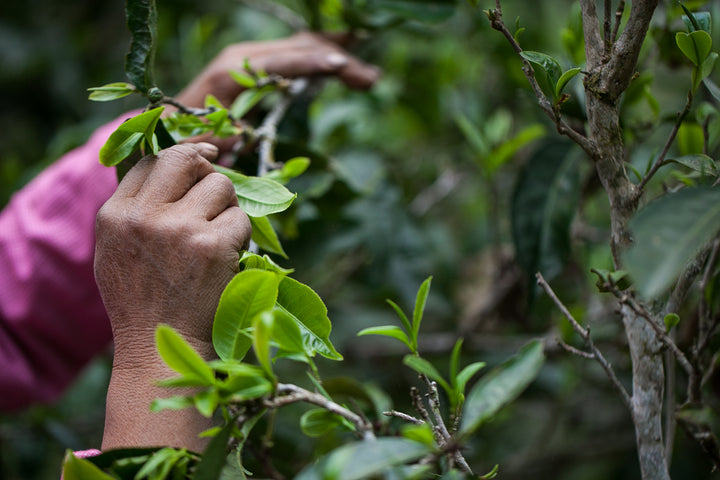
The standard for plucking fresh leaves requires that harvesting occurs after the tender shoots have developed a dormant bud and when the top leaf has just unfolded to a small or medium open-leaf stage. At this point, a bud with two or three leaves is plucked.
During the harvest the rule of the "Five Don'ts" is strictly applied:
- do not break the leaf blade,
- do not fold the leaf,
- do not crush the leaf tip,
- do not include single leaves,
- do not include old leaves or old stems.
Fresh leaves from tea trees growing in different areas must be kept separate.
Leaves picked in the morning, noon and evening must be processed strictly separately, with noon leaves considered the highest quality.
During the entire processes, tea leaves go through: Plucking, Sun Withering, Indoor Withering, Shaking/Tumbling, Fixation, Roll-Kneading, Initial Baking, Second Baking, Repeated Roll-Kneading, Slow Drying over Low Heat, and Sorting.
Historical Development
Tieguanyin is the name of a specific tea plant variety that originated in Xiping Town, Anxi County, Quanzhou City, Fujian Province, and was discovered between 1723 and 1735.
There are two historical anecdotes regarding the origin of the name 铁观音Tiě Guānyīn:
One story claims that the Qianlong Emperor, observing the dry tea leaves were heavy as iron - 铁 tiě - and the brewed leaves were as beautiful as the face of 观音 Guānyīn - the Bodhisattva or Goddess of Mercy.
Another tale recounts a devout Buddhist tea farmer who, following a dream in which Guanyin goddess appeared to him, found an excellent tea plant and later transplanted it into an iron cauldron (Tie Ding), thus naming it Tieguanyin.
Anxi, the origin area of Tieguanyin, is adjacent to Quanzhou, facilitating maritime trade. In the early 20th century, this excellent cultivar spread to Southeast Asia with waves of emigrants and also crossed the sea to Taiwan.
The term "tieguanyin" also refers to a method of tea production. Traditional Tieguanyin is a Wulong tea made from mature, open leaves, with a high degree of oxidation, possessing ripe fruit and roasted aromas, and shaped into spherical or semi-spherical form.
Over time, the tea leaves used to produce Tieguanyin are not necessarily from the Tieguanyin cultivar, and the processing has also changed significantly. The degree of oxidation and roasting is generally not as high as in traditional versions.
In a broad sense, "Tieguanyin" has transcended specific origin and cultivar, becoming a product name for a Wulong tea that exhibits a specific aroma and flavour profile.
YUNNAN TIEGUANYIN CHARACTERISTICS
The cultivated Yunnan Tieguanyin has a golden liquor, prominent sweetness and freshness, a very pure and mellow strength, and a smooth, moist texture without any dryness.
It is a Wulong tea characterized by freshness, sweetness, mellowness, and smoothness.


Wuyi Mountains, Fujian 福建省武夷山
Zhengyan Rougui 正岩肉桂
Rougui, also known as Yugui, is one of the famous cultivars within Wuyi Rock Tea, named for its spicy aroma which reminds of the Chinese cinnamon - Ròuguì 肉桂.
Zhengyan Rougui represents the very pinnacle of the Wuyi Rock Tea pyramid. The Wuyi Rock tea production area is classified into four grades: Zhengyan - True Core Rock, Banyan - Middle Rock, Zhoucha - Riverbank Tea, and Waishancha - Outer Mountain Tea. Among these, the "Zhengyan" producing area is located in the core zone of the Wuyi Mountain Scenic Protection Area, including the famous "Three Pits and Two Streams" : Huiyuan Pit, Niulan Pit, Daoshui Pit, Liuxiang Stream, and Wuyuan Stream.
The Zhengyan producing area possesses a unique Danxia landform. The soil has high gravel content, excellent permeability, and is rich in minerals, providing an exceptional environment for tea tree growth. The tea produced here has a pronounced mineral taste and superior quality, making it the finest among Wuyi Rock Tea.
Zhengyan Rougui can be broadly divided into two types based on topography:
Rock Summit Tea: Tea trees grow in relatively open terrain with slightly longer exposure to sunlight, slightly less time bathed in mist and clouds, and a higher probability of absorbing weathered minerals from the rock cliffs. Representative areas include Matou Yan's Kaishan Ping and Tianxin Yan. The aroma is bold and assertive, with a spicy, sharp cinnamon bark scent that can excite the sensitive nerves of Rougui enthusiasts, quickly triggering dopamine.
Pit & Stream Tea: Distributed in low-lying areas within the Zhengyan region, often at the bottom of basins, pits, and gullies. From a naming perspective, any site with a prefix like pit, stream, cave, or lair falls into the Pit and Stream Tea category. Unlike Rock Summit tea, the growing environment for Pit and Stream tea is cooler, with more mist and cloud moisture. Nestled between cliffs, the Rougui trees at the bottom receive slightly less direct sunlight, and a gentler, more diffused light. Therefore, the aroma profile of Pit and Streams Rougui Tea can be summarized in four words: quiet, subtle, lingering, and long-lasting. The tea fragrance sinks into the liquor, never overpowering, but delicate, like the fine brushwork in a Song Dynasty painting, meticulously outlined stroke by stroke.
The production of Zhengyan Rougui follows the traditional Wuyi Rock Tea process, including steps such as withering, shaking, shaqing, rolling, and baking. Among these, shaking and baking are two crucial procedures.
During the shaking process, the tea master must rely on experience to master the skill of Kan Qing Zuo Qing (Observe the leaf and make the tea accordingly), allowing the leaves to undergo appropriate oxidation to form the unique aroma and taste of Wulong tea.
The baking traditionally uses charcoal firing, a slow "simmering" over gentle heat that allows the tea to absorb the fire thoroughly, resulting in a more profound and enduring fragrance.
HISTORICAL DEVELOPMENT
Wuyi tea has been celebrated for over 2000 years, with a documented history of tea production in Wuyi Mountain spanning more than 1500 years. The area boasts a vast variety of tea cultivars, earning it the title "Kingdom of Tea Cultivars."
Before the Yuan Dynasty, Wuyi tea primarily consisted of compressed cake tea and steamed/sun-dried loose tea. Pan-fried green tea emerged in the Ming Dynasty.
By the early Qing Dynasty, Wulong tea (yancha), black tea, and Longxu tea had been developed, with Wuyi Mountain being the birthplace of both wulong tea and black tea. The Qing Dynasty was a period of great development for Wuyi tea, which evolved from green tea to Wulong tea - Wuyi Rock Tea.
In the early Qing, Yin Yingyin, the magistrate of Chong'an County, invited monks from Mount Huangshan in Anhui to make Songluo green tea. Through repeated experimentation and improvement, the processing technique for Rock Wulong tea was first formed in the late Kangxi period, leading to the production of Wuyi Rock Tea.
TEA CHARACTERISTICS
Zhengyan Rougui not only inherits the cultivar's characteristically sharp and spicy cinnamon bark aroma but also incorporates the distinctive mineral essence unique to the Zhengyan terroir, forming a unique flavour profile.
This tea is rich in aromatic layers: the dry tea leaves carry a caramel-like sweetness. When smelling the heated lid of the gaiwan, the cinnamon bark aroma is pronounced, with complex aromas of fruit and flowers emerge.
The liquor is mellow and full-bodied: the tea liquor is smooth, velvety, and dense on the palate, with a powerful mineral flavour and a persistent sweet aftertaste.
Soft, Bright, and Even Spent Leaves: After brewing, the leaves are thick, soft, and pliable, with vermilion red edges and a yellow-green center, commonly known as "green leaves with red borders."
The lingering note of Zhengyan Rougui is distinct from that of Banyan or Waishan teas, by a clear sweet aftertaste and lingering note.
The aftertaste is like the echo of a fine tea. Shortly after drinking the tea liquor, a sweet, pleasant sensation arises on the tongue and throat.
The lingering note is somewhat more abstract. Unlike the straightforward sweet sensation of the aftertaste, after drinking Zhengyan Rougui, smacking your lips and savouring carefully reveals a subtle, serene charm—refined and evocative.


Wuyi Mountains, Fujian 福建省武夷山
Banyan Rougui 半岩肉桂
Banyan refers to the area within Wuyi Mountain but outside the "Three Pits and Two Streams," including the peripheral rocky zones along the Jiuqu River edge (about 60–70 km beyond the Zhengyan core).
Banyan tea gardens are primarily composed of red siliceous-aluminous soil with many small gravels. Compared to the towering giant rocks of Zhengyan, the landform here has already changed.
The unique quality of Wuyi Rock Tea is shaped by three main factors:
1. Wuyi Mountain’s distinctive natural ecological environment;
2. Excellent tea cultivars suitable for producing Rock Tea;
3. Unique traditional production techniques.
Banyan terrain lies in a transitional zone between Danxia landform and valley landform. The soil is mainly thick rocky red earth, relatively sticky and dense, with a thinner soil layer, high aluminum content, very low potassium, and high acidity. Key production areas include Qingshi Yan and Bishi Yan.
Wuyi Wulong PROCESSING
The tea buds of Wuyi Rougui sprout around mid-April, with rock tea plucking
starting in early May. Generally, only one harvest is taken per year, mainly
focusing on spring tea. Plucking must be done on sunny days, when the new
shoots have developed into a dormant bud with an open top leaf—referred to as open leaf plucking—and two or three leaves are picked.
Fresh leaves from different terrains and grades should be processed separately, applying different techniques and measures.
Today’s production still follows traditional manual methods. The fresh leaves undergo over a dozen steps including withering, making green, kill green, rolling, and baking.
Proper withering of the fresh leaves forms the foundation of aroma and taste, while shaking is the key step defining Rock tea’s character. During the shaking process, strict technical principles must be followed:
- heavily withered leaves are shaken lightly,
- lightly withered leaves are shaken more,
- more shaking, less handling,
- starting light and short, then increasing intensity and duration,
- always “Observe the leaf and make the tea accordingly” (Kan Qing Zuo Qing).
In recent years, the rolling drum-type comprehensive tea fermentation machine has become the common method for performing the shaking process.
TEA CHARACTERISTICS
Its characteristics are expressed as rocky backbone with floral aroma — meaning the tea liquor is thick and smooth, the fragrance is pure, deep, and lingering, the sweet aftertaste is quick and distinct, and the flavor persists for a long time.
Banyan Rougui offers a mellow and harmonious liquor with a quiet, subtle aroma, though its mineral taste is less pronounced than that of Zhengyan tea. It stands out for its high cost-performance ratio, making it well-suited for daily enjoyment.


Wuyi Mountains, Fujian 福建省武夷山
Gao Shan Rougui 高山肉桂
The northwestern part of the Wuyi Mountain range is dominated by the highest peak in Eastern China, boasting an exceptional ecological environment.
In recent years, high-mountain ecological Rock Tea from Wuyi has emerged as a standout, known for its superior quality, unique high-mountain character, and mineral flavour.
Its production is primarily concentrated in high-altitude areas within Wuyi, such as Wusandi, Chengdun, Tongmu, Zhukeng, Sixin, Dalanqian, and Chaotian.
The tea grows in soil conditions characterized by semi-weathered parent rock and gravel, combined with a unique high-mountain regional microclimate.
Processing
The production process follows the standard Wuyi method.
It requires moderate sun-withering and moderate handling during the making green stage. The entire process from shaking through shaqing must maintain a "continuous fragrance," with the aroma transforming from a fresh fragrance towards floral and fruity notes.
GAOSHAN ROUGUI CHARACTERISTCS
Influenced by its special natural climate, the Rougui tea produced here has a mellow and thick flavor, a clean and elevated floral aroma, and a distinct cinnamon bark fragrance.
Its unique taste profile differs from that of standard Wuyi Rougui; the tea's flavoUr is sweet and clear, its aroma is high and assertive, and it feels smooth, thick, and mellow on the palate.


Wuyi Mountains, Fujian 福建省武夷山
Zhoucha Rougui 洲茶肉桂
Zhoucha (Riverbank Tea) refers to tea produced in flatlands and along riverbanks, outside the Banyan zone but still within the boundaries of Wuyi Mountain.
Zhoucha is produced in sandy soil tea gardens near rivers like the Chongxi and Huangbaixi, flatland tea areas along roadsides, and also includes tea gardens on yellow soil and those converted from rice paddies.
Zhoucha tea gardens receive direct sunlight, resulting in more low-boiling-point aromatic compounds that are not long-lasting. The finished tea has a relatively strong taste, but its inner substance is not sufficiently rich.
The production of Zhoucha Rougui follows the standard Wuyi process. It requires moderate sun-withering and moderate handling during the shaking stage. The entire process from shaking through shaqing must maintain a "continuous fragrance," with the aroma transforming from a fresh fragrance towards floral and fruity notes.
Historical Development
Different periods have seen varying classifications of Rock Tea producing areas.
The emergence of Wuyi Rock Tea can be traced back to the mid-to-late 17th century. An earlier written record is the essay 'On Wuyi Rock Tea' by Li Yuankuan, a Jinshi (metropolitan graduate) of 1628, the first year of the Ming Chongzhen reign.
Subsequently, the tea industry in Wuyi Mountain gradually entered a prosperous period with numerous categories.
Lu Tingcan's Supplement to the Classic of Tea from the Qing Dynasty quotes the Suijianlu as follows:
"Regarding Wuyi tea, that which grows on the mountains is called Rock Tea (Yan Cha), while that which grows by the water is called Riverbank Tea (Zhou Cha). Among Rock teas, those from the northern mountains are superior to those from the southern mountains. Teas from both the northern and southern mountains are also named after the specific rock/cliff they originate from. The finest among them is named Gongfu Tea. Even above Gongfu, there is Xiaozhong, which is named after the specific tea tree variety, each tree producing only a few liang - a small unit of weight-, making it exceedingly rare.
The various types of Riverbank Tea include Lotus Heart (Lianzixin), White Hair (Baihao), Purple Hair (Zihao), Dragon's Whisker (Longxu), Phoenix Tail (Fengwei), Flower Fragrance (Huaxiang), Orchid Fragrance (Lanxiang), Clear Fragrance (Qingxiang), Deep Fragrance (Aoxiang), Selected Bud (Xuanya), and Zhang Bud (Zhangya)."
Prior to 2002, veteran tea masters like Mr. Yao Yueming represented a clear classification of producing areas into Zhengyan, Banyan, Zhoucha, and Waishan (tea gardens within Wuyishan City jurisdiction but outside the Wuyi Mountain Scenic Area). In 2006, "Wuyi Rock Tea" became a protected geographical indication (PGI) product, and this detailed origin classification was no longer officially used.
ZHOUCHA ROUGUI CHARACTERISTICS
With the assistance of modern processing techniques, the quality of Zhoucha Rougui is acceptable.
The tea liquor tends to be overall "mild," with a relatively simple aroma (which may be cultivar-derived or process-induced), a somewhat thin body, a coarser texture ("water path"), and average durability.


Nanping, Fujian 福建省南平市
Waishan Rougui 外山肉桂
Waishan Rougui (Outer Mountain Rougui) refers to tea produced outside the jurisdiction of Wuyi Mountain, in areas such as Jian'ou and Jianyang, characterized by large yields.
The production areas for Waishan Rougui experience long hours of sunlight, resulting in tea leaves that are thinner, lower in moisture content, and possess a strong, sharp aroma.
When processed using the Rock Tea method, the resulting Rougui has a stimulating, pungent fragrance.
WAISHAN ROUGUI CHARACTERISTICS
Waishan Rougui tea is relatively light and thin, lacking in mellow thickness.
The first and second infusions represent the peak of its taste, offering a sweet aroma. It can be brewed 7–8 times.
TEA AND INCENSE
To deepen our journey into the world of Wulong tea, this chapter includes a sample of our Osmanthus 桂花 - Natural Chinese incense.
We invite you to experience the art of tea and incense pairing. As you brew your Wuyi Rougui or Yunnan Tieguanyin, light a stick of this delicate incense and observe how its honeyed apricot scent and soft woody undertones interact with the complex aromas of your Wulong - creating a new dimension of fragrance that enhances both the tea experience and the moment.
map of wulong's production areas
Our journey follows the path of Wulong tea across its most significant terroirs. We begin in the mineral-rich cliffs of Wuyi Mountain in Fujian, where rock and mist create the distinctive Yancha. We then travel to Yunnan's high-altitude forests, an important region where exceptional growing conditions yield Wulong teas with remarkable fragrance and complexity.
The route connects these diverse landscapes where tea plants grow in rocky soil, thrive in subtropical climates, and benefit from mountain elevations.
Each environment contributes unique characteristics to the leaves that are carefully transformed through the art of oxidation.

taste more
Wulong Tea
Continue your journey through the depths of Wulong Tea tasting other teas in our collection

VISIT US IN YUNNAN AND TRAVEL THROUGH TEA LANDS
Tea Tours '25/'26
We welcome visitors in our land all year round, guiding groups through tea places from East to West China
Expand your senses and follow your body feelings
Natural Incense
Try brewing Wulong tea with other natural incense from our collection.
