天时地利人和
Tiānshí Dìlì Rénhé
Timing, Terroir, and Cultural Harmony
Timing, terroir and cultural harmony: it is the sentence we choose to describe this year's harvest, as a line that unites these three elements: the rain that gently nourishes the soil, reaching the roots of the tea trees and blooming their leaves, and then the cultural harmony, as all the human processing that was possible exactly thanks to the first two elements, interlaced in the right moment.
This kind of convergence is more than agriculture, and we like it because it is a flow - and actually, it doesn't mean to be perfect, because each present moment, if we are able to let it flow, has its own perfection.
The tea itself will tell you if one of the elements didn't really fit together with the other two; it is direct, and it touches our senses and our body as a whole, and we just need to listen to our brewing.
In this article we are going to go deeper in each of these elements, 天时, 地利, and 人和, describing the current season and what we expect from its output.

天时 Tiānshí — The Right Timing
This is the season itself: the weather, the rhythm, the patience of the mountains.
From February onward, the temperature in Xishuangbanna rose slowly and steadily. This is not always the case; some years the heat comes in fast, forcing the trees to push leaves quickly and coarsely. This year the rhythm was more balanced, and the mountains stayed wrapped in mist through much of the early growth period.
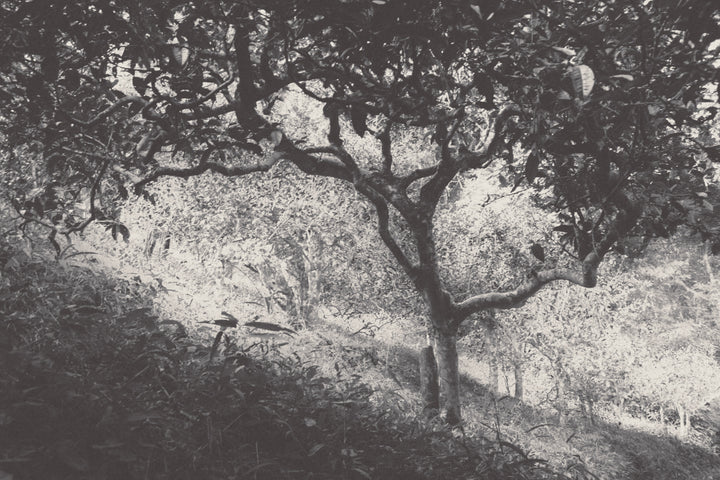
Mist is actually very important for our Yunnanese style of agriculture: who visited us knows that in Nannuo we have almost 200 days per year of fog, and many of you have enjoyed the landscape in the humid months.
With the change of light and cool humidity of cloud cover, the tea plant slows down its synthesis of catechins — the compounds responsible for bitterness and astringency — and instead accumulates amino acids and aromatic substances at a higher rate. The result is a leaf with more freshness, more complexity, more of what tea people call 鲜爽 Xiānshuǎng — a word that can be translated with something between vivid, clean, and alive.

Too much direct sun, too much heat, and the balance shifts: the catechins dominate, the bitterness hardens, and the leaf loses the delicacy that makes a mountain tea worth drinking slowly.
When the time came to pick, the rain held back, and this is perhaps the single most important weather variable of the production process, discussed especially among professional.
If rain falls during the withering period — the hours immediately after picking when the freshly harvested leaf is spread to lose moisture and begin its enzymatic transformation — the consequences ripple through every stage that follows. For example, a withering that should take three to five hours extends to seven or more, with the high humidity inhibiting the enzymatic activity, thus slowing the very reactions that develop the tea's character. The leaf's own respiration accelerates, consuming sugars and amino acids — the compounds that give the tea its sweetness and freshness — before they ever reach the cup. So, a part of the aromatic substances volatilise and are lost. The risk of mould also increases, with microbial growth introducing off-flavours that no amount of skill in later stages can fully correct.
This year we had on average dry harvest days, the withering clean and controlled, and the aromatics stayed in the leaf - where they belonged.
The final variable is the one most visible, and perhaps the most discussed locally: the drying. Yunnan's traditional sun-drying 晒青 is not only a practical step, but is considered essential to the character of the finished tea, and to its potential for ageing. Leaves dried under full sun develop differently from those under shade or artificial heat, with a more open, expressive taste that locals describe as the terroir speaking directly.

When the weather is unstable, with alternating clouds and rain forcing producers to dry under sheds, the tea acquires what farmers here call a "stifled" quality: 闷住的, that can be translated with "sealed in itself", never quite releasing its full potential. It is still a good tea, but something is held back, as if the leaf never fully opened.
This spring the sun was generous and consistent: the drying was traditional, and the teas came out with the open, transparent quality that makes Xishuangbanna spring teas worth ageing for years.

One small note on the leaves themselves: in this year's brews, especially in the first two infusions, you may notice a few translucent flakes in the liquor. They come from a fine, semi-transparent peeling at the petiole of many leaves, that is the small stem connecting leaf to branch. It looks, at first glance, like a defect, but it is actually a sign of good growing conditions: abundant sunlight through the growth period reduces the internal water content of the leaf, and when the dried leaf is rolled after kill-green, the drier tissue at the petiole separates slightly - the way skin peels in a very dry climate. It has no effect on flavour, they are simply the memory of a sunny spring.
That was 天时. Timing, in perfect alignment.
地利 Dìlì — The Right Place
This is the land itself: the mountains, the soil, the unique voice of each slope and elevation.
Xishuangbanna is not one terroir but many, and this season we travelled and tasted widely - across both the western mountains, including Bulang and Laobanzhang, and eastward through the Yiwu area. The quality was consistent across all, but each mountain expressed the 2026 season differently, because each mountain is different; we report below some broader anticipation, inviting you to read further on the single tea description as soon as they are published (or writing us anytime you feel like!).
Bulang: higher altitude, cooler nights, a powerful minerality in the soil. The teas this spring showed their characteristic structured bitterness, but with a faster resolution than usual. The bitterness opens, then softens, then releases a long, rising sweetness that stays in the throat. Locals say Bulang tea has bones — a skeleton of tannin that holds everything upright. This year, the flesh on those bones was generous.
Laobanzhang: the most famous name in Bulang and in pu'er tea generally, and for good reason. The ancient trees here are older than most recorded history in the region; their roots go deep into weathered sandstone and shale, drawing up minerals that translate into a liquor of extraordinary depth. The 2026 Laobanzhang we tasted had the signature wild, almost medicinal intensity, but with a clarity that previous vintages sometimes lacked - the dry spring concentrated everything.

Nannuo: our own forest, our home taste. It has a softer, more approachable character, with honey notes, a creamy texture, and a gentler entry that makes it a tea for morning drinking, or for introducing someone to the world of ancient-tree sheng. This year's Nannuo surprised us: the honey was still there, but underlying it was an even stronger structural firmness, as if the trees had decided to grow up a little.
Yiwu: east of the Luosuo River, a different world entirely. Yiwu's terroir is more humid year-round, the mountains gentler, the soil richer in decomposed organic matter. The teas from here have a floral, almost perfumed elegance, with gardenia, white orchid, and many more, and a soft, enveloping mouthfeel. The 2026 Yiwu was as graceful as ever, but with a surprising brightness that made each infusion feel like the first.
That was 地利 Dìlì, the land, speaking clearly through each mountain.
人和 Rénhé — The Right People, and Cultural Harmony
This is the human element: the pickers, the processors, the families, the generations of knowledge passed down through hands and stories.
In Xishuangbanna, tea is not only a crop, rather for most of the people, tribes, illages, is an ancestral relationship — between the Dai, Bulang, Hani, and Jinuo communities and the trees their ancestors planted centuries ago.
As it is always the case, also this year the picking was done mostly by hand, evaluating tree by tree, day by day, branch by branch, the number of leaves picked together with a bud. The people's hands know which bud is ready and which needs another day, and that knowledge is not written down: it comes from years of practice with all the steps of tea, from its roots to the cup drunk daily with their families; and their roots date back many generations, when gongfucha was an unimaginable future.

After picking and withering, there is immediately the kill-green 杀青, that is the moment when human skill matters most: if processing the tea leaves is the art to stabilise the leaves drying them with a different application of heat, during a different time curve, here things happens the fastest and the hottest, and this is where the highest risk of making mistakes lies, that will influence the ageing of tea.
If the wok temperature is too low, the enzymes remain too active and the tea will oxidise like a black tea, turning brown and losing its potential for ageing before it is even pressed. If the temperature is too high, the enzymes are completely destroyed, and the tea will not age becoming, in effect, a green tea: aromatic for a year or two, then flat and mute. If the heat is excessive, then, the leaf scorches, the aromatics burn off, and the tea tastes of charcoal rather than mountain.
Working the wok - in any form, including the latest generation automated ones - requires a feel for the heat and the fragrances that come from the heated leaves matured from years of listening to the leaf crackle, watching the steam rise, knowing exactly when the heat had done its job, at the right time.
Beyond the technical skill, there is something larger: cultural harmony. The villages of Xishuangbanna are not collections of individual farmers competing for the best price, but rather communities bound by ritual, festival, and a shared understanding that the forest must be treated as a living relative, not only a resource. This is especially true in the protection and valorization of the tea of the whole mountain - when a tea is exceptional, it is celebrated as a mountain achievement, not an individual one.
This year, that harmony showed itself in the consistency of the teas: across different villages, different elevations, different ethnic traditions, the processing was clean, the drying was careful, and the leaves arrived at the press in very good condition.
That was 人和 Rénhé. Not just hands, but a culture of harmony that has sustained these trees for generations.
Across the Mountains — A Summary of 2026
Bright entry, clean bitterness that resolves fast, a long sweetness in the throat — what the Chinese call 回甘 Huígān, the returning sweetness, the aftertaste that lingers and grows, that was present across everything we tasted this spring.
The cakes are being pressed now. The papers — our new designs! — are printed and ready, and soon each tea will be wrapped and set aside, without hurry, with no need to be the first to make them available in each corner of the Earth.

This is perhaps what distinguishes pu'er from almost every other category of tea: it is made thinking to the following years and even decades, aware that its processing - and somehow its life - will unfold away from us.
The pressing, the wrapping, the storage are the beginning of a longer journey: a sheng pu'er pressed this spring may reach its first interesting stage of transformation in three or four years, and may be at its best in fifteen or twenty.
In an age of immediate consumption, this tea invites us to trust the moment we think right for us - for ourselves, our taste, our pace, while encountering the tea leaf.
天时地利人和 Tiānshí Dìlì Rénhé. The right time, the right place, and the right people — living in cultural harmony.